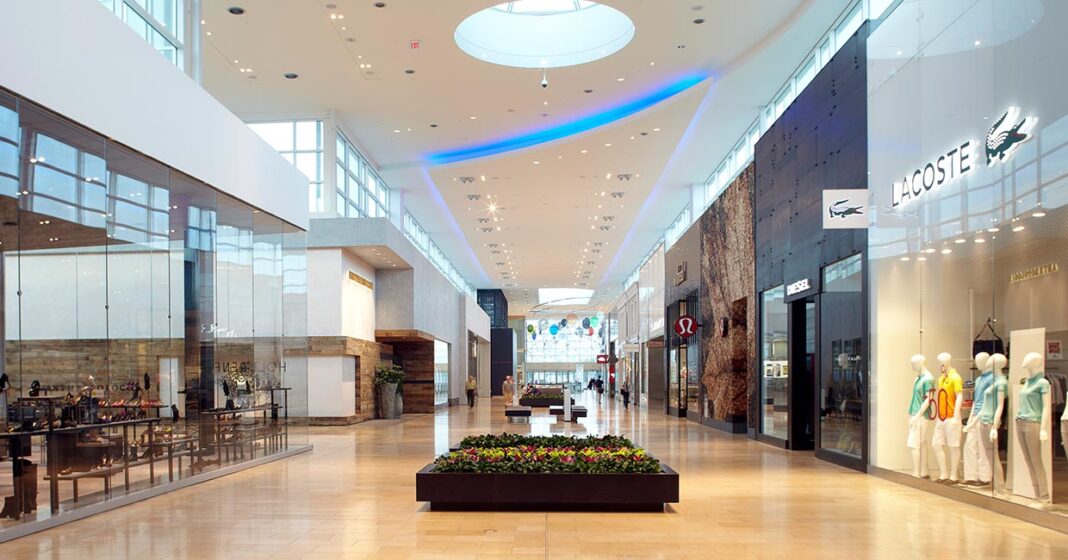



(Yorkdale: Photo: Oxford Properties Group)
By Randy Harris, President of Trendex North America
Two events occurred in Canadian apparel retailing earlier this year that, while not coming as a surprise, still require a comment.

The first involved the news that both Jean Machine and Grafton Fraser, Inc. had filed for Creditor Protection. In addition, German women’s apparel retailer, Gerry Weber, announced it was closing its eight corporate owned stores. Over the past three years a predictable pattern of post Holiday Season store closings has emerged. So the fact that three company’s made similar announcements really should have not come as a surprise.
The second development also involved a predictable occurrence. Industry savants have opined that the fate of the three retailers were preordained as they operated in the middle of the apparel market. The corollary that inviably followed was that the middle of the market was a dead zone, as consumers were trading up or trading down. To that contention, Trendex notes the following:

- Over 80% of Canadian apparel retailers operate in the “middle of the market”, so it should not come as a surprise that the overwhelming number of apparel retailers that experience financial problems are in the middle of the market
- If the low-end of the market is growing, why are the sales of Walmart Canada, YM Inc. and the Inc. Group not increasing?
- Just because a group of retailers are labelled “off-price” does not mean they should be lumped in with true low-price retailers, including Walmart Canada. Without a doubt, the products/prices at Saks OFF 5TH and Marshalls are the same or often more than comparable items Sears sells. Because an off-price retailer sells a pair of $200 women’s jeans for $52 does not make it a bottom-tier retailer
- Fast fashion retailers are usually included in the definition of low-tier retailers. Obviously Zara’s pricing would preclude it from ever being considered as a bottom-tier retailer
- Many apparel retailers that define the middle of the market, including Marks, Moores and the Hudson’s Bay continue to prosper. Simons certainly could not be considered either a low-end or high-end retailer, as such it must be included in the middle of the market
- There is no statistical evidence (only anecdotal evidence) which substantiates the contention that Canadian apparel consumers are trading up or down. If such evidence exists industry savants should share it.

In commenting on the closing of stores, Doug Stephens, CEO of Retail Prophet noted, “their cases are really symbolic of the struggles that most mid-tier fashion retailers have been experiencing.” This publication is in total agreement that many mid-tier fashion retailers are struggling, however their problems are a result of two groups of factors. The first are external, including the growth of e-commerce and the influx of foreign apparel retailers. The second group of factors are internal, or self-inflicted if you will. They include troubled apparel retailers including Sears Canada’s failure to:

- Offer consumers a high value product
- Delineate a unique selling proposition
- Operate a first-class e-commerce program
- Implement a comprehensive marketing plan which communicates the retailers USP
- Close underperforming stores
Readers will note that one of the factors does not involve consumer’s wholesale abandonment of the middle of the market. Without a doubt some consumers are truly trading up or down, but this publication would contend that the number that do so, are far too few to explain the problems that some retailers in the middle of the market have experienced.

It would be safe to assume that what most “consultants” do not realize is that the middle of the Canadian apparel market is undergoing a period of “creative destructionism”. During this evolutionary retail period, Canadian consumers will continue to move up, down, and in many cases sideways, but within the middle of the market. Consumers might migrate to Frank & Oak or Zara, but they are still staying within the boundaries of the middle of the market. Canadian consultants will continue to mischaracterize what is going on with the middle of the Canadian apparel market until they realize that retailers like Marshalls have as much in common with Walmart as Donald Trump has with his predecessor.

(Randy Harris)
This article appeared earlier this year in Canadian Apparel Insights, a monthly publication by Trendex North America. For more information and to subscribe, visit the Trendex website.