

By Iuliia Nesterenko
Product recommendations are an important part of nowadays email marketing. When configured properly, they can bring numerous benefits such as increased reading time, click rate, and average check. What’s more, you can team up email recommendations with personalized website recommendations to deliver omnichannel shopping experience and make interaction with your brand even more satisfying.
Another advantage of product recommendations is that you can personalize them and tailor to each particular recipient based on their website behavior, shopping history, and previous response to your campaigns. You can use web tracking or API to collect data, which will be used to build corresponding blocks with product recommendations.
Marketers will also be happy to know that recommendations are built automatically. You configure a recommendation algorithm (category of recommended products, number of displayed items, exclusion conditions) and assign it to the necessary email template. The system will automatically fill cards with relevant recommendations.
How to Use Product Recommendations in Emails
As with any other tool, you fit recommendations to your general marketing strategy and particular campaigns. However, there are types of email used by every type of business – promo, welcome email, confirmation, abandoned browse, abandoned cart. You can add to them a block with recommended products that would serve different purposes, depending on the email.
Welcome Email
A welcome email is the first message people receive having subscribed to you. Since they’ve opted to hear from you, they’re likely to be ready to explore your products and give them a try. You may use recommendations to introduce some and show people what direction to move in.
This approach is especially applicable to emails with promo codes or other incentives like free shipping, discounts on the first order, etc. Show people what they can spend them on by presenting your best offers.
Sending recommended articles to new blog newsletter subscribers is also a good idea. If you have topic preference settings, build recommendations on categories people have specified as most interesting.
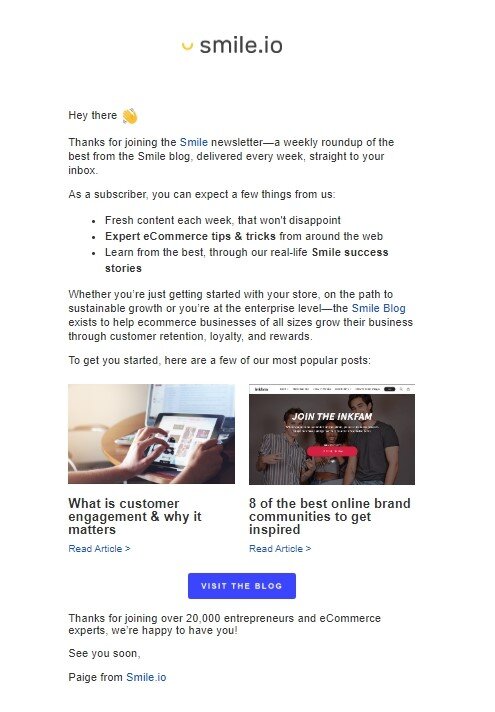
There are people who subscribe to you after they’ve been browsing your website for a while. There are those who subscribe after the first visit. For them, you won’t have enough data to build personalized recommendations, so include in welcome recommendations the best of have to offer – bestsellers, most viewed products, products with high ranking on marketplaces.
Also, mind that a welcome email is only the first email people receive from you. Don’t be too pushy from the start. Two-three recommendations are enough to make a friendly invitation to your website without sounding too forward.
Promo Campaigns
Promotional emails are the basis of your marketing strategy. At initial stages, they serve to promote your services, introduce arrivals, notify on sales and discounts, tell about events and activities, and turn prospects into customers.
Further, you send promo campaigns to keep on the conversation with your brand, reactivate sleeping customers, build loyalty, offer lucrative offers to the most devoted audience. Whatever stage of the marketing funnel you’re at, product recommendations can make your emails more informative and appealing.
What’s more, promo campaigns probably have the most options for blocks with recommendations. Depending on the email, they can be
● You might also like;
● Most popular;
● Back in stock;
● Recommended for you;
● Limited stock;
● Sales;
● Price cut;
● What we love;
● Styles for you;
● Best of, etc.
Imagination is your only limit, and you can get wrong with any option provided it resonates with the content and purpose of the email campaign.

Order Confirmation
Confirmation emails are sent after the purchase has already been made. Their task is not to sell but to provide information on the order, shipment status, and payment. However, you can add a block with, let’s say, 3 complementary recommendations that would match or complement the current purchase. These recommendations shouldn’t display the same product as the one that was just ordered. The customer has already made the choice. Your job is to what other items can go hand in hand with it, and they are preferably to be of the same price range.
If you use AI-supported recommendations and have enough behavioral data on the particular customer, machine algorithms can determine the pattern and predict the next demand. For example, if the customer has sequentially bought a bike, helmet, and air pump, their next purchase might be brakes or a flashlight. Price range and brand preference (if any) can also be considered, so you can offer the product that fits the exact current needs of your clients.
Abandoned Browse & Abandoned Cart
People may interrupt their interaction with your website, be it abandoned views or not completed orders, for several reasons: bad connection, slow page load, inconvenient navigation, not clear payment process, out-of-stock items, etc. However, the most common reason is that they couldn’t find what they were looking for or weren’t quite satisfied with the result.
Add to the abandoned cart email a few alternatives people might have initially missed out on. That might drive them back to your website and reconsider their order.

Of course, the above advice isn’t final; you can use product recommendations in any email. It’s not exclusive of one particular campaign type. Recommendations in email is a marketing tool alongside other practices. It has many applications:
● direct subscribers to a particular product category;
● promote selected products;
● promote complementary products;
● focus on currently relevant offers;
● increase email read duration;
● increase average order value;
● re-engage subscribers and drive them back to your website.
Apart from merely commercial purposes, recommendations are also a design element. They can shape email layout, determine reading flow, and help organize content in different ways. When combined with other marketing practices, like Artificial Intelligence, dynamic content, personalization and segmentation, product recommendations can deliver a more satisfying shopping experience and even anticipate demand.

Author’s Bio: Iuliia Nesterenko is a technical writer at eSputnik. Her focus is on exploring current digital marketing trends and describing new strategies for email marketers.

