

From among the entire spectrum of online retailers and sellers, price adjustments for supermarkets are some of the most complex. To the extensive catalogue of products are added the existence of other sales routes – such as the omnipresent physical route, which still monopolises almost all transactions made to purchase groceries, household pharmaceuticals, and consumer staples.
For the supermarkets that have joined in the digitalisation of their business (that is, that aren’t digital natives and, therefore, existed before, not only selling online), monitoring market prices is one of the most complicated tasks, remaining an essential step in becoming more competitive.
If we go to the data, the digitalisation of the weekly shopping continues to grow timidly. According to the data from Nielsen, online grocery sales have increased by 15% since 2016. From all these buyers, the main purchase motivation is seen in heavy, non-perishable articles, such as laundry and household items. In fresh products, however, this is a task that remains, to a large extent, unfinished. The majority are still those who use both the physical and online channels to make their domestic purchases. This means that the supermarkets have to continue paying a lot of attention to what happens in their physical establishments, in each of their aisles and shelves, with the consequent effort that this supposes in time, money, and personnel.
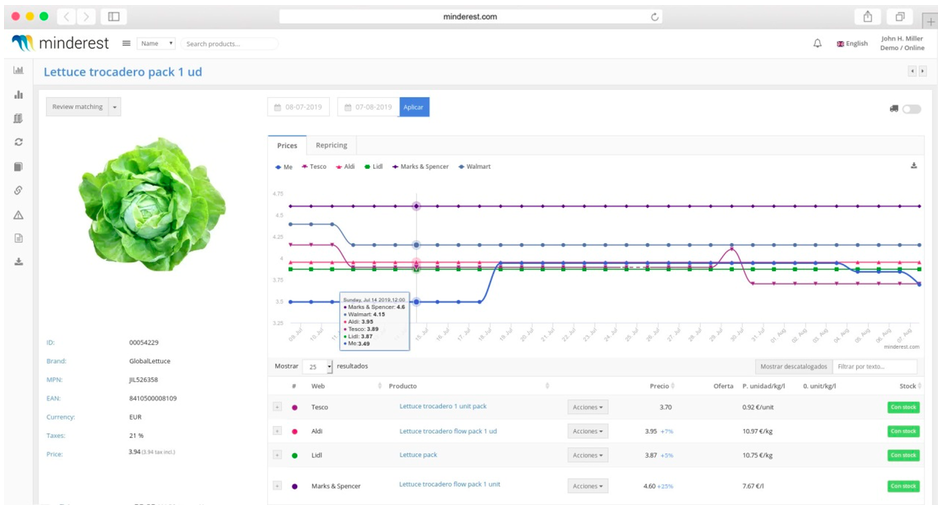
Even so, the technology exists that can assist this type of online store with the omnichannel management of their prices. Large brands like Carrefour and Leroy Merlin use the pricing tool from the company Minderest, whose unique solution can monitor and compare the prices of each product, both in-store and online.
This pricing solution, which they have named InStore, allows each eCommerce business or online supermarket to monitor the prices of their competition regardless of the channel, giving them the possibility to craft an omnichannel pricing strategy that takes all of the promotions and discounts offered into account.
Technology supporting competitiveness
Until now, eCommerce businesses and the pricing managers of the different supermarkets had to personally monitor each of the products and prices from each competitor. Thanks to techniques like big data, this is no longer necessary. With the help of the dashboards required by each supermarket customer, any business manager will be able to see the changes that are occurring in the market firsthand.
In this regard, it should be noted that these management and support tools for online supermarkets are also key for keeping them at the level of competitiveness necessary to maximise profits.
Dynamic pricing is a cutting-edge pricing strategy, one that adapts the prices of the products based on the market situation, the demand, and the prices set by the competition.
If we talk about keeping a tight grip on what each competitor is doing, imagine the arduous task of carrying out a manual adjustment of each and every one of those prices. Machine learning has allowed companies like Minderest to offer their clients the possibility of executing price changes that keep them at the forefront in order to take advantage of maximum opportunities.
A price improvement algorithm works by comparing the prices of the other supermarkets, proposing and executing the appropriate modifications based on the parameters defined by the client. This is a vital aspect of the tool since it allows each supermarket to adapt the price fluctuations to its style, margins, and objectives.
What are the positive effects of this technology?
The use of this type of software allows three things, above all:
1. Omnichannel sale parameterisation;
2. Monitoring of all of the supermarket’s conversion points; and
3. Adaptation to distinct situations and submarkets, depending on factors like geolocation and the product stock in the warehouse.
From a global perspective, these omnichannel pricing tools improve the cross management of the business above all. That is, they help maintain better control over what’s for sale.
On the other hand, it should be noted that, with the low use rates of the online sales route in supermarkets, it’s essential to maintain a strategy that’s aligned in all of its aspects. If we’re talking about promotions, it’s clear that many respond to the sales route being used. Consumers are aware of this and act accordingly.
However, if we treat the economic term as an absolute value, the perception of having different sales prices for the same product depending on where it’s purchased is something else completely. This is a very important factor when it comes to transmitting trust and creating a community of consumers that are loyal to the eCommerce brand.
Key point summary
● The increase in online grocery sales is not yet comparable with purchases in physical stores.
● Supermarkets need omnichannel management of their pricing strategy to maintain competitiveness while remaining true to their brand image.
● Pricing solutions like that from Minderest allow for the comparison and automation of price readjustments in supermarkets while taking market fluctuations and competition into account.
*Data sources:
–Global online grocery purchasing is up 15% in last two years, leading to an estimated us$70b in additional sales in online fmcg https://www.nielsen.com/eu/en/press-releases/2018/global-online-grocery-purchasing-is-up-15-percent-in-last-two-years/
