




image of cf toronto eaton centre. photo: cadillac fairview

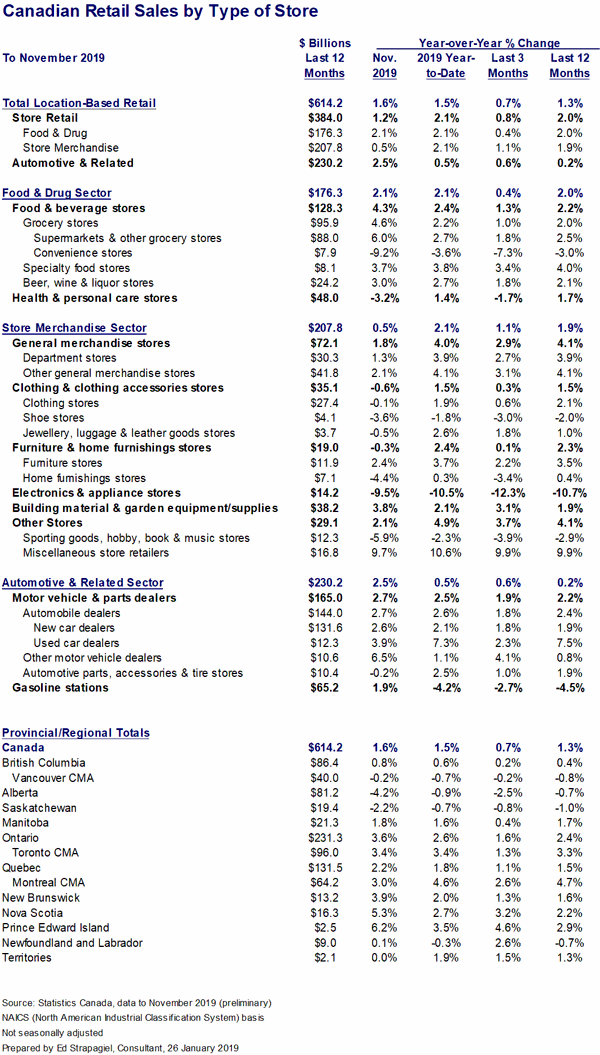
The latest data from Statistics Canada indicate that overall retail sales increased just 0.7% year-over-year for the 3 months ending November 2019. While an uptick was reported in the media for November alone, this was in comparison to the previous month, October 2019, which was particularly weak. For retail sales numbers, one month does not a trend make.
After 11 months of 2019, year-to-date overall Canadian retail sales were up just 1.5%, well below the approximate 3.5% pace needed to keep up with population growth and price inflation. It’s virtually certain that 2019 retail sales growth will end up at a 10 year low.
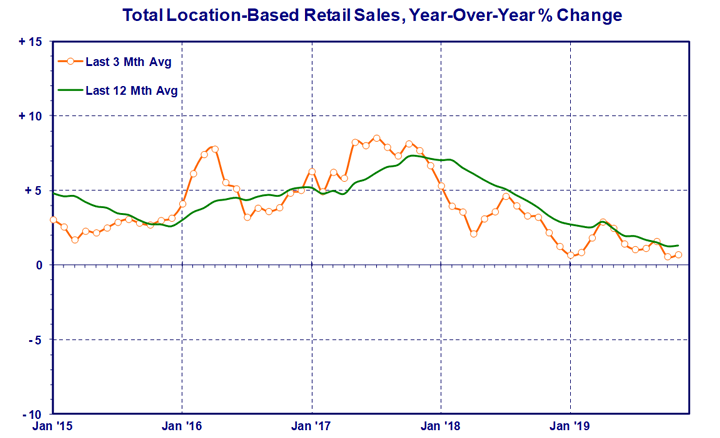
As the above chart shows, the underlying 12 month trend (green line) peaked two years ago in late 2017, and has been declining ever since. The shorter term 3 month trend (orange line) continues to underperform even that, indicating more weakness ahead.
Unusually low growth in the Food & Drug sector since mid 2019 is probably the most responsible for the recent deterioration of overall retail sales. The Automotive & Related sector has also been weak but steadily so. Store Merchandise is more or less holding its own but at a historically modest retail sales growth level.
Food & Drug
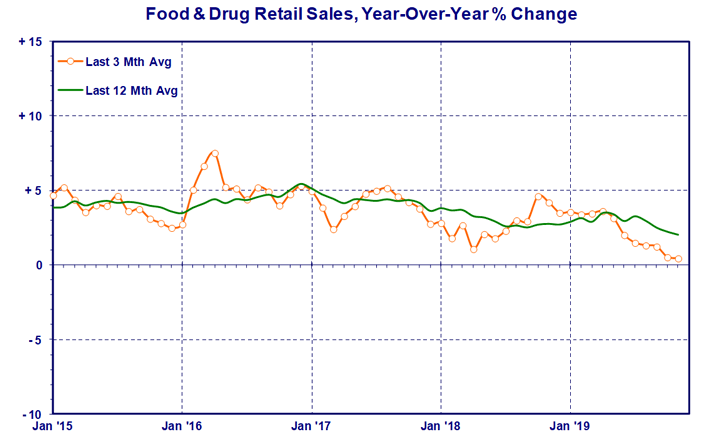
Retail sales growth in the Food & Drug sector is scraping rock bottom. Year-over-year sales were up a mere 0.4% for the 3 months ending November 2019, another historical low.
The 3 month trend (orange line in the chart above) has steadily deteriorated in the second half of the year. The underlying 12 month trend (green line) is also weakening as a result, and may end 2019 at about 1.8% or 1.9% gain.

photo: loblaws
Retail sales at grocery stores gained 1.0% for the 3 months ending November 2019. This was constrained by convenience stores where retail sales declined by a huge 7.3%.
At the same time, health and personal care stores failed to pick up the slack. Their sales were off 1.7% year-over-year for the period.
Store Merchandise
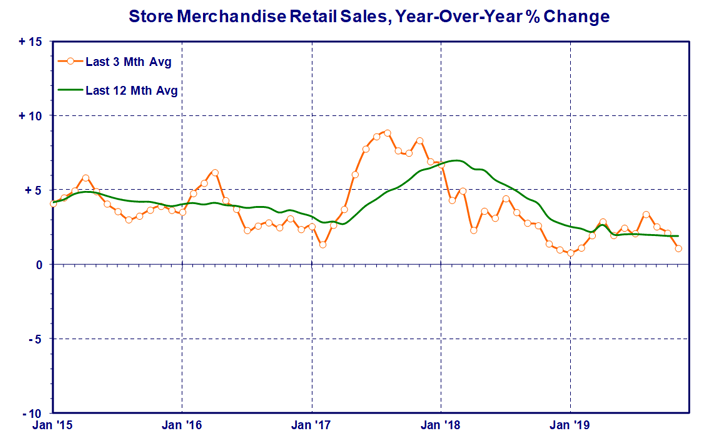
The Store Merchandise sector has been holding its head above water for most of 2019. The latest results however may be of concern, as retail sales were up just 1.1% for the 3 months ending November 2019. Year-to-date retail sales however were still up 2.1%, so there’s hope yet.
For about the last 8 months, the short term 3 month trend (orange line in the chart) has been fluctuating somewhat, both up and down. The offsetting pattern has meant that the underlying 12 month trend (green line) has been about flat, which is actually an improvement over the weakening evident in the other major retail sectors.
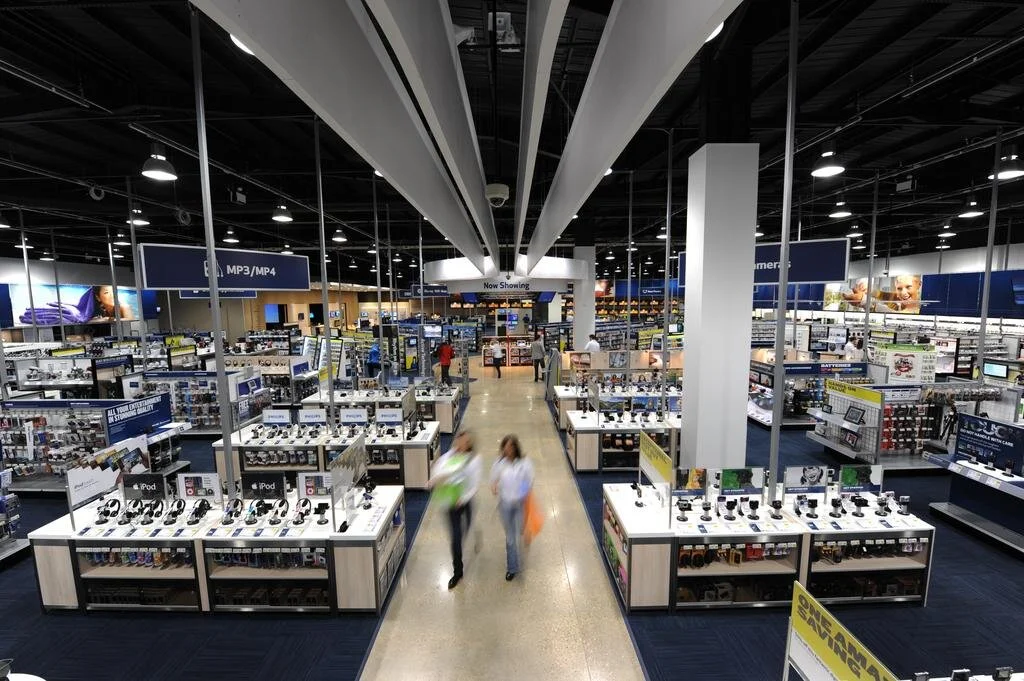
photo: the business journals
There are still some problem areas in Store Merchandise. Electronics & appliance stores’ retail sales were down a huge 12.3% for the 3 months ending November 2019. Shoe stores, home furnishings retailers, and sporting goods, hobby, book and music stores also reported declines, while clothing stores were up only 0.6%.
Miscellaneous store retailers had the highest sales gain of 9.9% for the 3 months ending November 2019. This is largely due to the addition of cannabis stores a year ago, an affect which will dampen down in the next few months.
Note that Statistics Canada is now suppressing the breakdown of general merchandise stores for confidentiality reasons. The figures in the “By The Numbers” table below are estimates based on previous trends.
Automotive & Related
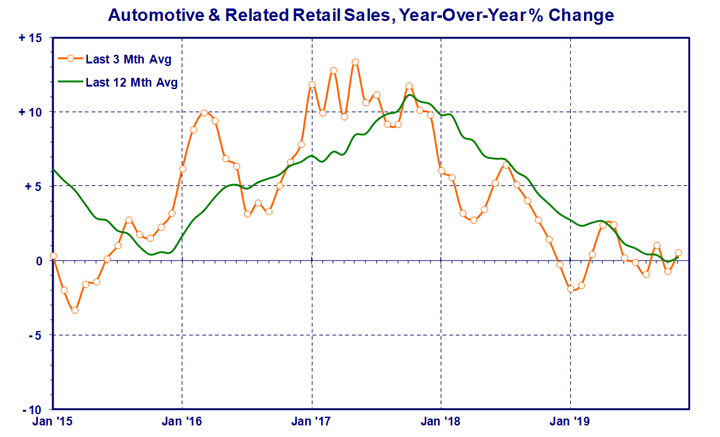
The Automotive & Related sector has come down hard since its glory days of 2017 to its current state of low to no growth in 2019. This is due to a “double whammy” of weak automobile sales and depressed gasoline prices.
Gasoline stations are the main problem for sector retail sales and for Canadian retail sales overall. Their sales were down 2.7% year-over-year for the 3 months ending November 2019, although this was not as bad as most of the preceding months. Without gas stations, overall Canadian retail sales growth would be up 2.2% year-to-date instead of 1.5%.

stock image
New car dealers’ retail sales gained a modest 1.8% for the 3 months ending November 2019. This offset the decline at gas stations, but it wasn’t enough to materially improve the performance of the Automotive & Related sector.
By The Numbers
Special Note: Statistics Canada revised historical data with the February 2019 release. Unadjusted monthly data were revised back to January 2018, while seasonally adjusted data were revised back to January 2015. Those keeping score should update their files. The analysis in this report is always based on unadjusted data.
Canadian E-Commerce Sales
StatsCan started providing e-commerce retail sales data in January 2016. While the amount of data is limited, some trends appear to be emerging. Here are some results.
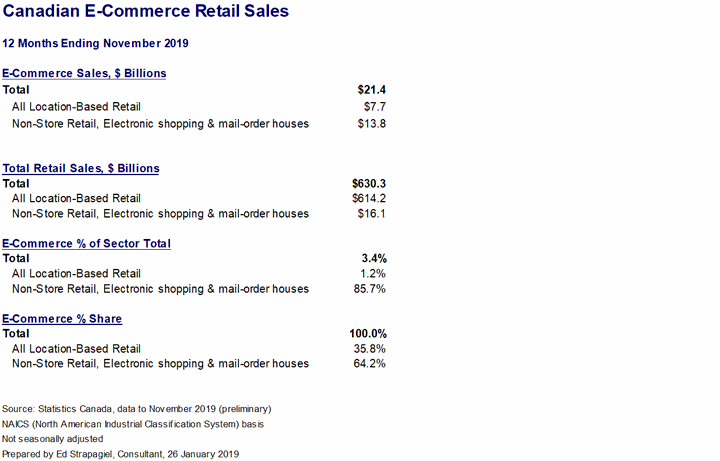
Overall, e-commerce represented about 3.4% of Canadian retailers’ sales for the 12 months ending November 2019, including both pure play operators as well as the online operations of brick & mortar stores. Canadian consumers however also buy online from foreign websites which is not captured in these numbers.

Canadian e-commerce sales were up 15.9% year-over-year for the 3 months ending November 2019. This was much higher than for location based retail which gained just 0.7%.
Note that location based retail is the same as that in the preceding “By The Numbers” table. It’s what’s normally reported as Canadian retail sales. Except that it isn’t. Location based retail excludes another section called Non-Store Retailers (NAICS code 454), which includes electronic shopping and mail-order houses, which in turn is where (mostly) pure play e-commerce businesses are. For the 12 months ending November 2019, electronic shopping and mail-order houses had an estimated $13.8 billion in e-commerce sales.
But that’s not the only source of e-commerce, as (mostly) bricks & mortar location-based retailers also sell online. For the 12 months ending October 2019, this group had an estimated $7.7 billion in e-commerce sales. With electronic shopping and mail-order houses, there’s a grand total of $21.4 billion in e-commerce sales by Canadian operators over the year. Note that this does not include foreign e-commerce purchases made by Canadian consumers, but it does include e-commerce purchases made by foreigners at Canadian operations.
For electronic shopping and mail-order houses, an estimated 85.7% of their sales are allocated to e-commerce. For (mostly) bricks & mortar retailers, it can be estimated that just 1.2% of their total sales are attributable to e-commerce.
In the final section of the above table, (mostly) pure play operators (namely, under electronic shopping and mail-order houses) generated an estimated 64.2% of all e-commerce sales in Canada, while (mostly) bricks & mortar location-based retailers’ share of e-commerce was 35.8%.
For more explanation on the e-commerce numbers, see Statistics Canada: Retail E-commerce in Canada.
Monthly Update Notification
This analysis is updated monthly as new numbers are published by Statistics Canada. If you would like notification from LinkedIn of when an update becomes available (and you’ve read this far), please connect with Ed Strapagiel on LinkedIn.
26 January 2020

This analysis is updated monthly as new numbers are published by Statistics Canada. If you would like notification of when an update becomes available (and you’ve read this far), please connect with Ed Strapagiel on LinkedIn.
TODAY’S TOP HEADLINES

READ MORE ARTICLES BY ED STRAPAGIEL









"Without gas stations, overall Canadian retail sales growth would be up 2.2% year-to-date instead of 1.5%"
Most economist strip out the volatile gasoline sales, for Core Retail Sales.