


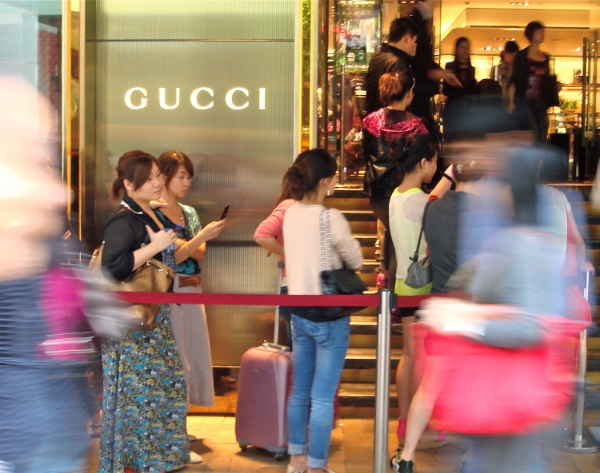
Photo: www.bonbrand.com
By Edward Quan
Canadian luxury retailers are targeting Chinese shoppers like never before. It should come as no surprise, given the tremendous spending power of Chinese tourists. Sources at Holt Renfrew‘s Vancouver store, for example, confirm that many of the store’s top spenders are Chinese, and that sales volumes from Chinese tourists are substantial. Other upscale retailers, especially in Toronto and Vancouver, say that they target Chinese tourists based on some of the statistics discussed below.
Chinese travellers have broken all records for spending over the past two years, shelling out over US $129 billion in purchases in 2013, alone. Recognizing this trend, several European fashion houses such as Chanel and Hugo Boss have launched their collections in Asia, via high-profile runway presentations. Chanel recently did a show in Tokyo, while Hugo Boss dis a runway presentation last spring in Shanghai. Efforts have paid off, as international luxury brands continue to see strong spending from Chinese tourists.
According to the United Nations World Travel Organization, China accounts for one out of every ten travellers, followed by Germans, Americans, British and Russians. In addition, the industry expects Chinese spending to almost triple by 2020, reaching US $300 billion. Surveys show that for over 80% of Chinese tourists on vacation, shopping is their top priority. In my experience as a luxury buyer in travel retail, for example, it would not be unusual for Chinese tourists to ask me what designer shops were available, and where.
Chinese tourists also lead in terms of tax-free transactions, spending an average of US $1130, compared to Russians with US $494 per transaction. This is not a surprising, given the size and the rapid growth of China’s upper and middle class. The Chinese are increasingly traveling abroad, partly due to relaxed government restrictions on foreign travel, high import duties and taxes on luxury goods at home, and rampant counterfeiting within China.
Understanding Chinese cultural nuances is paramount for retailers, and it’s not as simple having Mandarin speaking sales staff. Some retailers get it, specifically catering to the Chinese. Printemps department store in Paris, for example, now has a dedicated entrance for Chinese tour groups. Harrod’s in London has 100 China UnionPay card terminals located throughout the store, and both stores have Chinese language websites and maps. Closer to home, several Holt Renfrew stores now accept the China UnionPay card, as does Toronto’s Yorkdale Shopping Centre – the first Canadian mall to do so.
To reach these tourists, luxury retailers must recognize how the Chinese research their destinations prior to travel. Nearly half of Chinese residents now have internet access, with two-thirds of traveling Chinese researching their destination online. The majority use Chinese language search engines and social media platforms, so Chinese-language travel writers and bloggers will play an important role.
Another challenge facing tourist destination is that the Chinese stomach is “stubborn”, according to CC Zhuang, CEO of Qunar – China’s largest travel website. Chinese tourists want their congee – Chinese porridge – in the morning. European continental breakfast would not satisfy Chinese appetites, for example, as many Chinese are not yet ready to be totally immersed in the foreign food experience.
Due to language barriers, most Chinese travellers still travel in groups. The trend is changing, however, as we’re now seeing more young, affluent independent travellers from China. With only 5% of all Chinese currently holding passports, the potential for luxury retailers is enormous. By next year, Chinese tourists will purchase more luxury goods than tourists from all other countries combined. Success will come to those retailers who take the time to understand and meet the unique needs of the Chinese tourist.

Edward Quan is a luxury goods expert, based out of Vancouver. He is a fashion columnist with StyleDrama, as well as a freelance travel writer. You will also find Edward Quan at TheBahamasWeekly, as well as here periodically at Retail Insider.
CANADIAN RETAIL NEWS: Friday, June 20, 2014 (Updated Continuously)
GO BACK


I applied for a personnal shopping job at a luxury toronto department store. The person involved in the hiring process told me if I don’t speak mandarin than don’t bother.
The amount of money some Chinese women spend is jaw dropping – and many of them look like thy’re in the 20’s age group.
Very interesting. We’ve heard similar from other job applicants. Here in Vancouver, we’ve seen young Chinese women drop thousands at the local Holt Renfrew, Chanel, Hermes, and other luxury stores.
The ramifications for hotels and personal shopping are extraordinary. What will be interesting is how online shopping develops and if it will cut into the touristic spending.
Very good point. Holt Renfrew’s #1 personal shopper in Vancouver does over $4.5 million, usually speaking Chinese languages. Hotels will need to adapt, and online will be interesting. Provided the in-store experience is ‘exciting’, we think many Chinese shoppers will continue patronizing brick-and-mortar stores, partly for the prestige and social factor.