

Photo: Accent Labels
As Canadian brands and retailers become increasingly international, their products are being purchased by those who speak different languages. Besides potential confusion and mistranslation, individual country-by-country labelling standards are costing those in the industry who do business internationally, according to David Ceausu, President of leading Canadian based global apparel labelling company, Accent Labels.
Mr. Ceausu noted that if a label reads differently in one country versus another, moving that product to another region could become complicated. Removing the label and replacing it with another takes time and money, not to mention that it could damage the product. Mr. Ceausu explained how international labelling standards and utilizing symbols instead of words, could eliminate confusion and costs associated with multi-lingual labelling. A hybrid solution could also be acceptable, he said, utilizing localized labelling standards with an international label with easy-to-understand symbols.
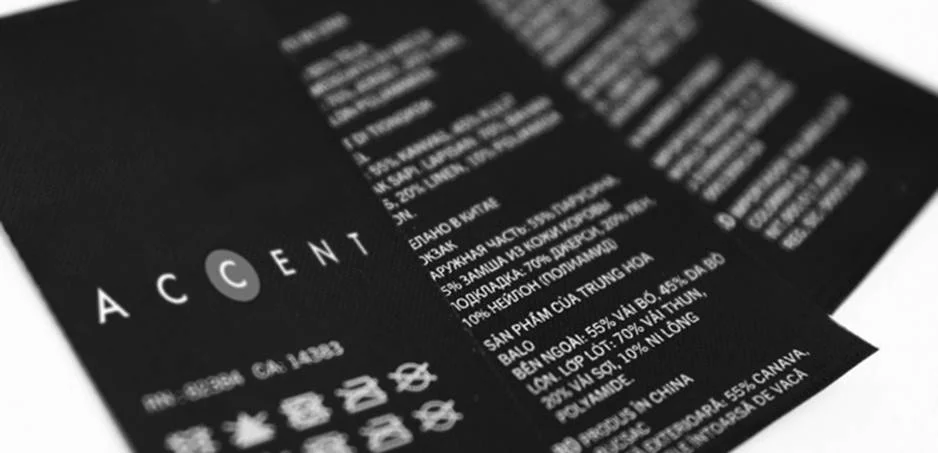
Photo: Accent Labels
For example, if a Canadian company wanted to sell its wares internationally and a particular style didn’t sell in one country, moving it to another would require replacing labels and tags marked in the local language. Standardized labelling would allow the company to more easily move merchandise internationally, without the inconvenience of relabelling. This applies more to brick-and-mortar retailing,though standardization would also benefit e-commerce, according to Mr. Ceausu,to create consistency.
Furthermore, Mr. Ceausu noted that standardized labelling could potentially eliminate confusion surrounding certain fabrics and other quality indicators. Although Canada’s Textile Labelling Act and the U.S. Federal Trade Commission may be of benefit to Canadians and Americans, countries such as India currently lack similar standardizing regulations. Standardized international labelling would provide consumers with insight into the fabric and care instructions, without the need for translation or for multiple/replacement tagging.
A recent study noted considerable differences among labelling standards, providing suggestions on how to streamline labelling standards for better international product movement. The study provided several potential solutions to try to create some uniformity, including ample use of percentages where appropriate, ASTM and ISO care symbols when possible, and even multiple tags for different country groups. The same study determined that ease of understanding and uniformity would be optimal and where possible, uniform labelling standards should be encouraged.
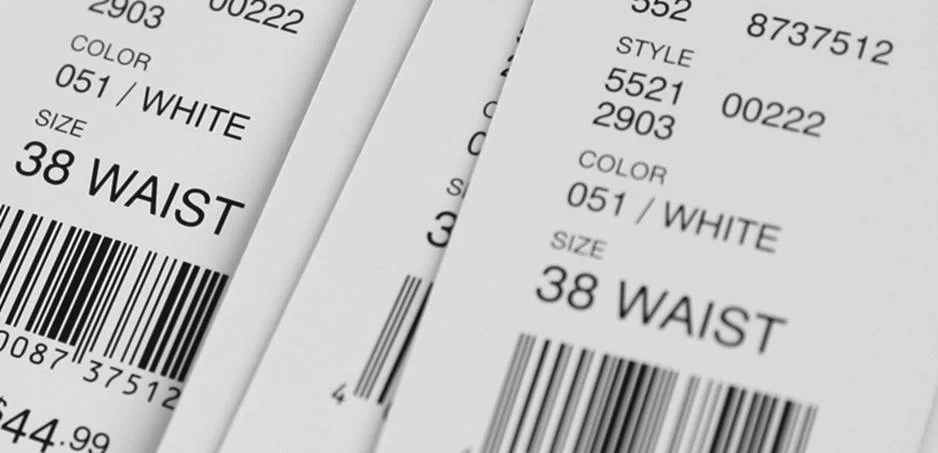
Photo: Accent Labels
Vancouver-based lawyer Ritchie Po noted that there could even be legal implications if mistranslation leads to false advertising or worse, someone is injured as a result of mislabelling. At the very least, mistranslation can lead to embarrassing situations — for example, translating ‘Made in Turkey’ into French could become humorous, if the translation results in the country being identified as a bird (dinde) as opposed to using its correct translation (Turquie). In the world of product labelling, however, humour and professionalism are often mutually exclusive.
As Canadian companies continue to move products internationally, at least partially standardized labelling would be of benefit. Mr. Ceausu explained that his company, Accent Labels, will adhere to any new industry practices that may involve new consistency standards.
Canadian Retail News From Around The Web: December 10, 2015