

By Randy Harris, President of Trendex North America [Subscribe to Trendex’ Canadian Apparel Insights]
Now that Sears has joined the storied list of Canadian retailers who have failed, including Eaton’s, Simpson’s, and Woodward’s, there are two remaining questions:
- Which apparel retailers will benefit from Sears Canada’s demise?
- Which apparel suppliers were affected by Sears Canada’s closure?
It would seem that everyone has their own list of ideas as to why Sears Canada failed. However, it’s important to understand that at least two of the reasons often given by industry savants contributed only minimally to Sears Canada’s demise. The first is that the retailer was positioned in the middle of the market. As Trendex has previously pointed out, many retailers positioned in the middle of the Canadian apparel market (e.g. Mark’s) continue to survive and in some notable cases prosper.
(Continued after the advertisement)

The second reason often given is that e-commerce’s growth adversely affected Sears Canada. Ironically, Sears Canada was one of the first Canadian retailers to launch an e-commerce site. Although the facts that Sears Canada has struggled with e-commerce and its e-commerce program was underdeveloped are undeniable, but so is the fact that e-commerce accounts for only 2% of Canadian retail sales versus 10% in the United States.

As such, even if Sears Canada had an e-commerce offering as good as its direct competitors, it still would not have saved the retailer. From this publication’s perspective, Sears Canada’s future was preordained when Eddie Lambert, in 2004, acquired 51% of Sears Canada. At that point, Sears Canada unfortunately became nothing more than a “piggy bank” for “Fast Eddie” and a parade of Sears Canada CEO’s followed who operated the retailer without the authority or vision to make the necessary changes to keep the retailer competitive.
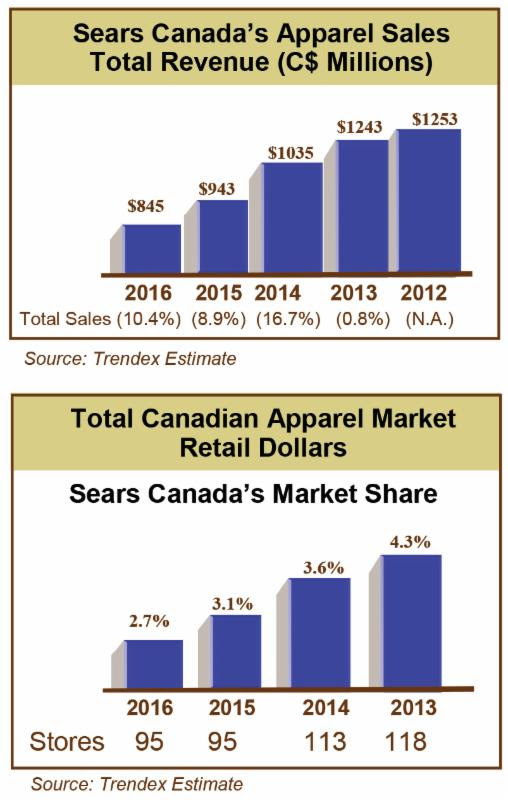
Prior to understanding the specific implications of Sears Canada’s failure for the Canadian apparel industry, its historical position in the market requires examination. Going back to 2012, Sears’ apparel division’s sales were almost C$1.3 billion. In that year it was Canada’s second largest apparel retailer. Five years later, in 2016, the retailer’s apparel sales were C$845 million and it had become the country’s fifth largest apparel retailer.

Assessing which apparel retailers will benefit from Sears Canada’s demise is relatively straight forward, given the profile of the Sears Canada’s customer, along with the retailer’s historic commodity strengths.

Ten years ago, Sears Canada’s strength was disproportionately among younger mothers, the middle class in general, and specifically among middle class immigrants, and seniors. During the past decade, Sears Canada increasingly lost their young-mother customer base to children’s specialty chains, along with others who offered a more obvious value proposition including Old Navy, Walmart Canada, and Winners. Going forward, while its not certain whose Sears Canada’s two core segments will specifically gravitate to, it is a certainty that the winning retailers will be those in the middle/older segment of the market including Reitmans, Costco, Winners and Walmart Canada. Marks should benefit from Sears’ historic strength in men’s workwear, while retailers including Northern Reflections should benefit from Sears Canada’s historic strength in older women’s casual apparel.

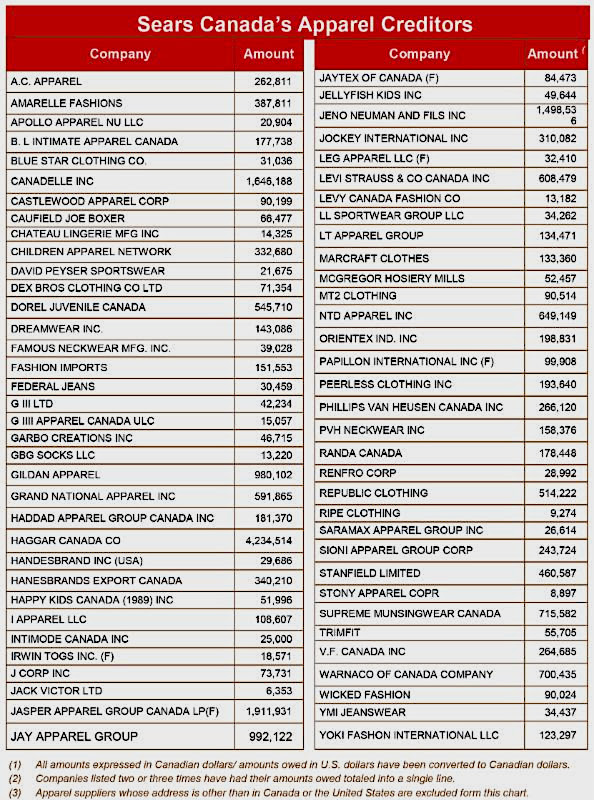
How will Sears’ failure affect the base of Canadian apparel suppliers as historically Sears Canada was the largest customer of Canadian apparel suppliers? Although Sears Canada’s dependence on its domestic supplier base had lessen over the past decade, it was still enormously important to a handful of suppliers including NTD Apparel, Jeno Neuman, Stanfield, and Orientex. According to Sears Canada’s, filing for protection in excess of 68 U.S./Canadian apparel suppliers were owed a total of C$21.8 million. At the end of this article is a list of Sears Canada’s apparel suppliers/creditors, not counting those headquartered in Asia. Note, all monies owed are expressed in Canadian dollars
In the case of the majority of the international apparel suppliers, the amounts owed to them by Sears Canada represents a small portion of their sales.
On the other hand, the monies owed to Canadian headquartered apparel suppliers including Stanfield, etc. represent a large portion of their annual sales. Worse still is the prospects of these companies replacing Sears’ lost sales.
Since at least the beginning of this decade it would be safe to say that watching Sears Canada’s performance was akin to watching a train heading for a wreck. It was obvious in the case of Sears Canada that the wreck was certain to occur, what was not known was when it would happen and how bad the wreck would be.
At least now we finially have the answers to both questions.

Randy Harris is president and owner of Trendex North America, Inc., one of North America’s largest marketing research and consulting firms specializing in the Canadian and Mexican apparel markets. As owner of this Toledo, Ohio based company; his area of specialization is the NAFTA apparel market. Follow Trendex North America, Inc. on Twitter at @Trendexnainfo
This article appeared earlier this year in Canadian Apparel Insights, a monthly publication by Trendex North America. For more information and to subscribe, visit the Trendex website.