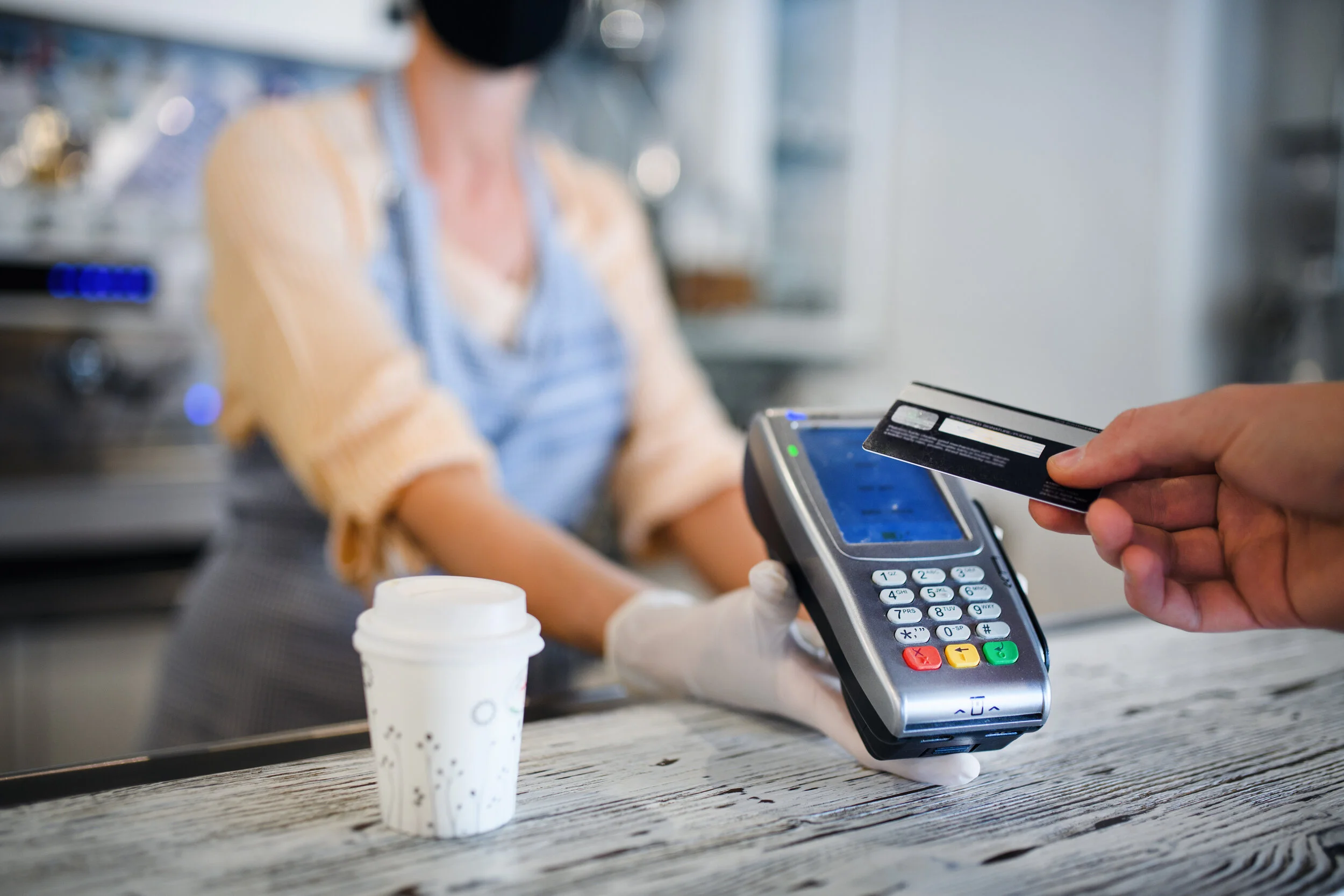
customer pays for coffee using contactless payment while cashier wears gloves and mask
By Peter Capponi
According to global engineering consultancy GHD, reopening and maintenance of retail operations can be safely achieved with proper resiliency planning aligned to business requirements and drivers, and a high degree of management and health and safety measures. This creates an environment to operate where employees feel comfortable and safe returning to work and customers feel safe shopping.
The establishment of temporary (or long-term) screening measures and diversions to meet social distancing requirements, that are monitored and managed digitally and aligned to retail flow patterns, coupled with robust communication strategies are a cornerstone of creating and reinforcing trust with all stakeholders as part of the overall response to COVID-19.
Retail Space Audits:
Determine sites and buildings to be re-opened and desired business level and activities. Perform an audit to understand demand conditions and site criticality to assess business continuity. Rank by safety considerations and facility layout and conditions. Evaluate economic impact to “bricks and mortar” operations and consider online sales avenues.
Health and Safety Facility Guidelines:
Determine public health and governmental guidelines during COVID-19 business activities. Understand and define safety guidelines for the facility and ensure that all government guidelines are incorporated. Conduct an assessment as to what is currently in place versus what is required and then plan to close the gap. For example, secure Personal Protective Equipment (PPE), and consider the availability of future stock and potential for supply chain disruption that could occur during an increased risk level.
Employee Health and Safety Policies:
Develop a site-specific employee safety plan with policies and protocols for health screening, social distancing and contact tracing. Conduct and document health risk assessment and develop appropriate PPE guidelines. Importantly, modelling of worker and customer movement will be critical to ensuring social distancing requirements tied to the specifics of the retail space/location. These policies and processes should be constantly reviewed and part of a continuous improvement strategy based on actual performance.
Consider Queuing Challenges:
Deploy digital technology and modelling to ensure social distancing and employee/visitor safety – specifically for queues and capacity requirements. Modelling and monitoring of movement outside and inside your facility will be critical to ensuring social distancing requirements.
Evaluate and Re-Engineer Floor Space Layouts for More Effective Physical Distancing:
Having the appropriate expertise, technology and data science to track, model, plan and implement effective social distancing in retail space is critical. Evaluate retail floor layout, product display options, and fitting room standards (eg. full doors versus curtains) that can safely accommodate people flow and contact interaction. This will lead to better health, safety and industrial hygiene protocols.
Cleaning, Disinfecting, and Decontamination:
It is important to respond to possible impacts and the needed prevention to identify and clean needed assets while maintaining retail flow, employee and customer confidence and product integrity.
HVAC Systems:
Infectious aersols can pose a high exposure risk, regardless of whether COVID is defined as airborne infectious disease. Evaluate and improve the design and operations of heating, ventilation and air conditioning systems and local exhaust ventilation (LEV) systems to decrease the transmission. Evaluate and develop strategies to minimize transmissions through ventilation systems including Dilution and extraction ventilation, pressurization, airflow distribution and optimization, mechanical filtration, ultraviolet germicidal irradiation and humidity control.
Effective and Regular Employee Communications:
Timely, consistent, and targeted communication and engagement is critical to the successful deployment of any significant business change. This should clearly articulate how a retail store is going to operate but also be clear how workers, customers and other stakeholders should behave. Given the personal nature of health screening and the fear associated with the COVID-19 virus, a comprehensive communications and engagement program is imperative.
Disclaimer: It is recommended that business owners and organizations monitor and adhere to the guidelines released by relevant public health authorities such as Health Canada, as well as other provincial authorities. Every business and organization’s situation is different. These tips are intended to raise awareness of a few best practices, solutions and considerations.

Peter Capponi is a North American Industrial and Manufacturing Sector Leader at GHD.
TODAY’S TOP HEADLINES

READ MORE ARTICLES FROM RETAIL INSIDER




![World’s 1st VUSE Storefront Opens in Downtown Toronto [Photos]](https://images.squarespace-cdn.com/content/v1/529fc0c0e4b088b079c3fb6d/1600809478182-51W99YAKSS061WZZZEA4/ke17ZwdGBToddI8pDm48kGhF2FCaXCFJZFEalRo8kqUUqsxRUqqbr1mOJYKfIPR7LoDQ9mXPOjoJoqy81S2I8N_N4V1vUb5AoIIIbLZhVYxCRW4BPu10St3TBAUQYVKc-1xO4ojbyXh6pGHoSehGwJrj31ldwyDpM9XrZmSoQV1hiaei2FKmHe5-h9rSbF7s/Screen%2BShot%2B2020-09-22%2Bat%2B5.03.35%2BPM.jpg)